H-Astronomy-004.htm
Astronomy-004 1950-2004
Humans
finally unravel birth of Cosmos, Solar System, Earth & Atoms
Our Origin

In
1948 George Gamo proposed the Big Bang concept for the origin of the
universe. This was not immediately
accepted, however in time astronomers agreed that the Cosmos began in what
became known as the “Big Bang” some 15 billion years ago. Abruptly energy at a center “exploded”
converting energy to mass according to Einstein’s E=mc2 with mass=m
expanding outward at the speed of light=c.
As mass expanded it gravitational pull caused matter to come together as
galaxies, stellar collections of swirling gas forming into stars and planets
now believed to have black holes at their core.

The Big Bang expressed in Time Space from a 2004 issue of Scientific American
By looking at distant objects and their motion astronomers believed they had a way to look into the past. They were amazed to find that all entities such as galaxies were moving away from each other – tracing back to a starting point beginning which they called the big bang. Once the Big Bang concept was accepted it was believed the cosmos was a fixed quantity – that eventually the momentum of expansion would be slowed down by the pull of gravity and the cosmos recycle itself.
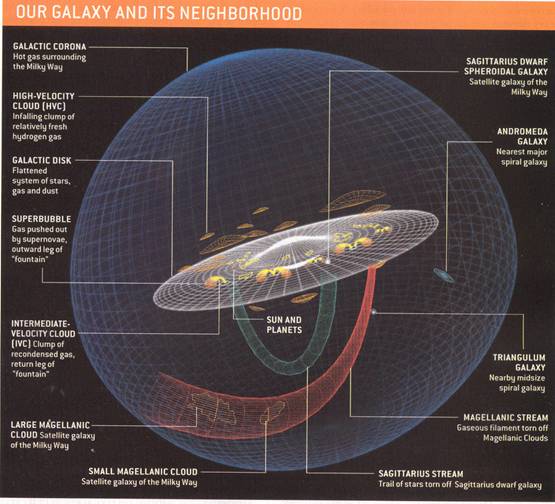
This 2004 image from
Scientific American shows what is currently known about our galaxy’s
environment.
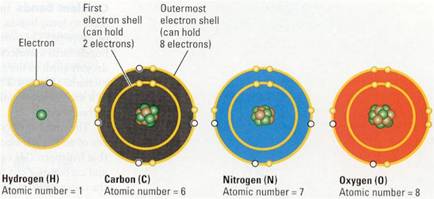
Basic atom building blocks
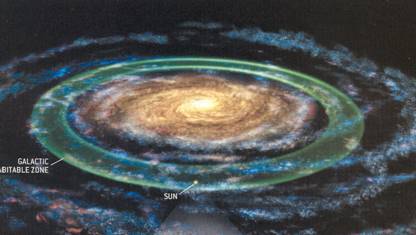
At 5.880,000,000,000 miles in one year, it requires 1,000 centuries for light to travel across our galaxy!
Our Galaxy is a collection of visible stars and other mater in the shaped of a disk. Our sun and solar system, which includes our space ship Earth – is in the outer fringe. Our galaxy is a tiny part of the Cosmos (the universe) which began as a big bang and is rushing into space. Man is still seeking answers to explain the unaccountable as did his ancestors of long ago.
Our Sun is a second generation small star created from matter exploded out into space by a large fast burning star that ballooned to a giant star and then exploded. The remaining matter, deprived of fresh combustible atoms, imploded on itself to form a black hole. A mass so heavy light cannot escape. Our sun will become a white dwarf as its too small to become a black hole.
Hydrogen is the smallest atom and the most abundant in
the cosmos. Enormous clouds are adrift
in space being pulled together by gravitational forces giving birth to
stars. Hydrogen is unevenly distributed
and collects to form stars. When the
mass becomes great enough the hydrogen burns in a nuclear process that radiates
light in the visual spectrum. The
combustion process produced bigger and bigger atoms causing the sun to become
larger and larger until, if large enough, it explodes. Astronomers call these flair ups “super
novas” – showing up as super bright star for a few days.
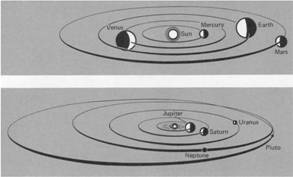
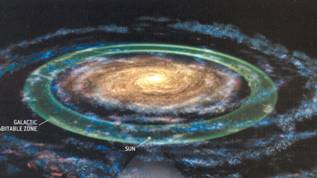
Our solar system within our Galaxy
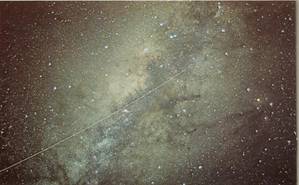
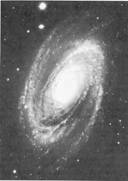
Milky way, our galaxy, as
seen from Earth Distant galaxy like
ours.
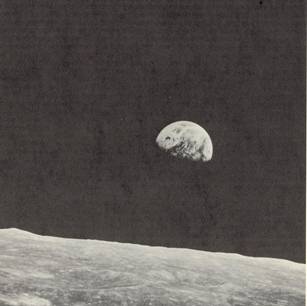
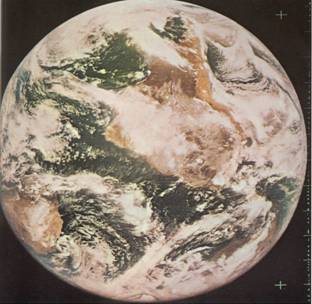
View of Earth from the Moon View of Earth from 22,300 miles
Life Cycle of Stars – Earth’s origin
Once knowledge of light, atoms and better instruments were available, astronomers from many places over many years were able to worked out the life cycle of stars. The digestion of information gathered between 1925 & 1950 permitted publishing results. With the mathematical description of what was going on inside of stars being published in 1984.
Clouds
of hydrogen are pulled by gravity, collecting in large masses. When the mass becomes great enough the
internal pressure ignites hydrogen causing the hydrogen to be converted to
helium, the next larger element. The
process continues, where a next larger atom is created from a smaller one. Huge masses of hydrogen burn faster than
smaller ones. The “burning stars” are
shown to follow a main sequence, as shown below. Those large enough reach a point where they expand, forming “Red
Giants”. Very large ones become
supergiants and eventually explode as “super nova”, emitting intense light as
they blow themselves apart. Our Solar
system, sun and planets, are the debris from such an explosion. The remaining star mass, now consisting of
heavy atoms shrinks and cools into a very dense White Dwarf all it’s “fuel”
having been consumed. An extra heavy White dwarf can collapse on itself to
become a neutron star, and large neutron stars further collapse to become a
black hole – so named because no light can not escape.
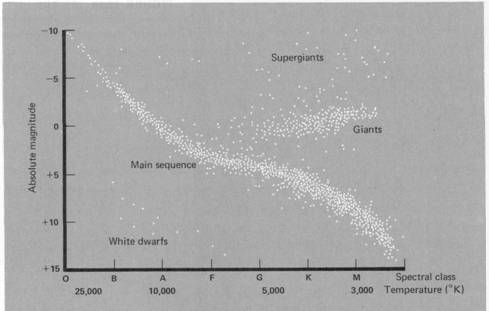
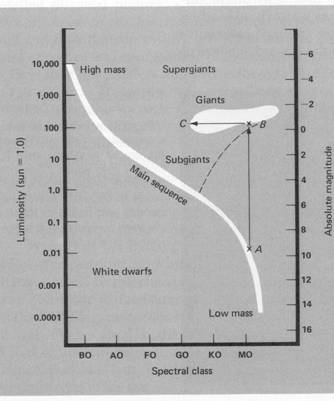
Hertzsprung-Russell main sequence diagram of the life cycle of stars

Temperature of star from end of main sequence, to Red Giant to White Dwarf

Structure of Star burning Hydrogen proceeding to “manufacture” Carbon
The above figure is best understood by reading “On Stars, their Evolution and their Stability” a paper by S. Chandrasekhar published in SCIENCE November 1984. This 9 page paper presents the mathematics of what is going on during the life cycle of stars, all the way to Black Holes. It’s fascinating reading, especially if you have sufficient knowledge of mathematics to appreciate the analysis. Double click on the above hyperlink to call up the paper.
Relativity & Cosmology
I
had taken a class in Astronomy in 1978 using a book printed in 1976. It
contained very little about Cosmology.
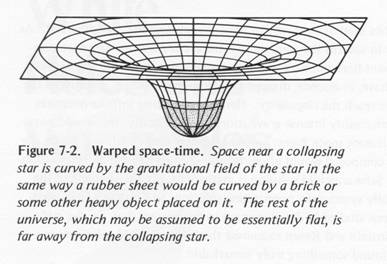
In 1979 I attended a special class on Relativity & Cosmology, the following diagrams are from a 1973 book prepared for that class. This shows how astronomers were thinking when George Gamo proposed the Big Bang concept.
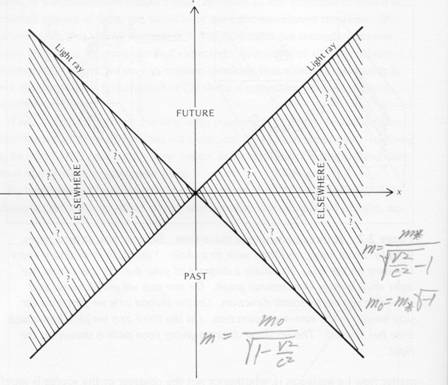
Time Space diagram from 1973 booklet on Cosmology
Cosmologists separate “space–time” into: past, future, knowable and unknowable – where the unknown is beyond the speed of light (radiation) which is our link to the past. Recording feeble radiation is seeing the furthest back in time – that radiation took the longest to get here. Whispers from space come the closest to “seeing” the big bang.
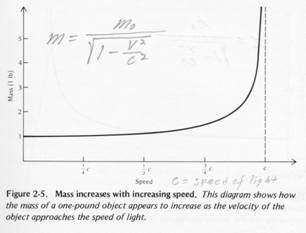
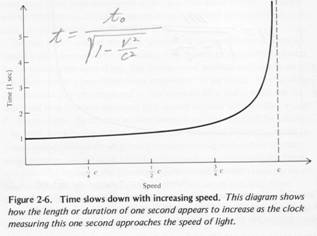
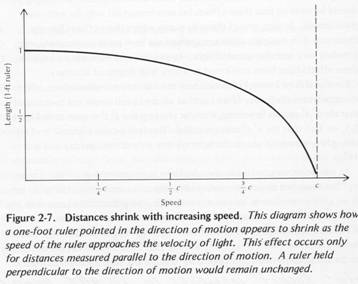
From Einstein’s Relativity E = mc2 mass & time are relative as shown above. Mass increases with speed, time slows down with increased speed.
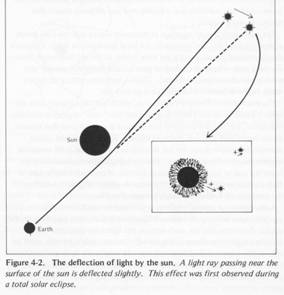
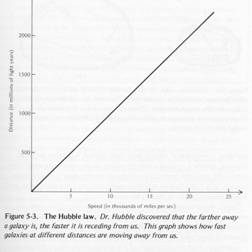
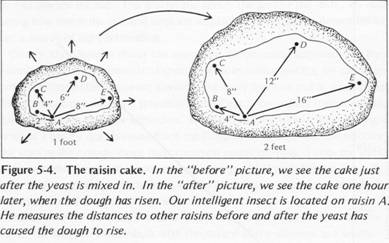
Galaxies at a distance are moving away faster than those close. Think of raisins in a cake, as the dough rises the raisins spread from each other. As we look, everything is moving away – the universe is expanding.
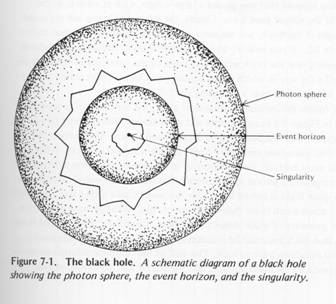
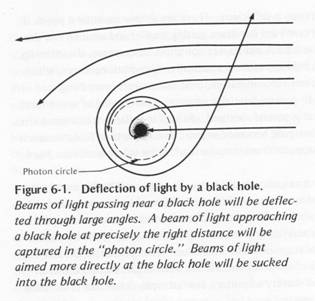
When a mass becomes great enough, atoms collapse, gravity is so great light cannot escape – thus the name black hole. The presence of a black hole is detected by the effect of it’s mass on other mass – they are detected indirectly. Material falling into a black hole becomes very hot giving off xrays before being swallowed.
Composition of the Cosmos:
The following pie diagram of the Cosmos, from 2004 Scientific American, shows that what we only “see” part of the Cosmos – invisible Dark Mater reveals it’s there by it’s influence.
Einstein had originally believed the cosmos was a steady state process where new stars are born as old stars die. Einstein worked hard to solve these dilemma and introduced a constant in his equations causing then to produce results that fit what was observed. At first all seemed well until near the end of his life he was informed the cosmos seemed to be ever expanding – there didn’t seem to be enough mass to slow the process.
A globally supported project to map all the known parts of the cosmos was initiated – to determine how evenly matter was distributed and more about it’s total mass. For a while it was thought there was a huge amount of unaccounted for mass in black holes and thin but vast clouds of hydrogen gas.
While astronomers were mapping the cosmos, others were engaged in Quantum Mechanics and using particle accelerators to break open atoms. They found that atoms were made of still smaller parts, slowly defining the several parts and their parameters.
The mapping process was not coming up with enough mass to slow down expansion, in fact it seemed cosmic rate of expansion was increasing. Things did not look right and many offered theories to forecast what the future would be like.
About 1998 Cosmologists believed they could prove their were huge amounts of Dark Matter and stuff they called Dark Energy. Einstein had found that Gravitational Attraction is effected by mass and pressure. On earth’s solar system gravitational the pressure is the same. But when dealing with other parts of the galaxy and the cosmos, pressure can have an effect on attractive forces. Astronomers are now finding themselves facing daunting dilemmas. This unknown something seems to be accelerating expansion? This something seems to be pushing rather than attracting – but the something is non-detectable except by it’s effect.

2004 Pie Chart of the Cosmos
In the above figure ordinary non luminous matter (black holes), in orange, is 3.5%; ordinary visible matter, yellow, .5 % and radiation .005%, we’ve been “seeing” only a fraction of the Cosmos!
A new term “quintessence” has cropped up as a fifth dimension adding ? to x, y, z and time.
Just as the ancients puzzled about the wandering stars, astronomers today puzzle – does dark matter possess negative gravity – does it accelerate matter by pushing rather than attracting?